
Asian Development Bank (ADB) on Friday warned that India's limited crude oil reserves of about 100 million barrels - sufficient for only 40-45 days of consumption - leave the country particularly vulnerable to supply disruptions through the Strait of Hormuz amid the ongoing war in West Asia.

US President Donald Trump has announced plans to clear the Strait of Hormuz to secure the vital oil corridor, citing risks to global energy supplies and criticising other nations' inaction.

Global energy markets saw a significant correction as oil prices nosedived following Iran's announcement that the Strait of Hormuz has been fully reopened, dismantling the 'war-risk' premium that had gripped the market.

India has commissioned its new indigenously-built nuclear-powered ballistic missile submarine INS Aridaman into service, further strengthening the naval component of its nuclear triad. Defence Minister Rajnath Singh also highlighted the Indian Navy's role in securing maritime trade routes.

The naval command underlined recent regional developments, which have now established a new reality in which extra-regional powers, led by Washington, DC, can no longer dictate terms or project unchecked influence in Iran's immediate maritime environment.

Addressing the 36th extraordinary session of the Council of the International Maritime Organisation (IMO) held on Thursday in London, the Indian envoy said, "India remains deeply concerned about the evolving situation and continues to call for de-escalation through dialogue and diplomacy, with utmost restraint and priority being given to the safety of civilians."

The US has threatened to prosecute those buying or selling sanctioned Iranian oil and has announced a blockade of the Strait of Hormuz after peace talks failed.

Ali Mousavi stated that such cooperation is essential for maintaining stability in the strategic waterway.

Trump criticised Iran for attempting to use international waterways for leverage, stating that the United States had restrained itself only to allow space for negotiations.

A senior Iranian legislator has suggested that Tehran could further escalate pressure on its adversaries by targeting the Bab el-Mandeb Strait, raising concerns about global supply chain vulnerabilities.

India has expressed strong concern over the targeting of commercial shipping in the Strait of Hormuz during the West Asia conflict, urging for the restoration of unimpeded navigation and global commerce.

An Indian-flagged crude tanker safely departed from the UAE's Fujairah after loading oil, despite an attack on the oil terminal. The Indian government is closely monitoring the situation in West Asia to ensure stable fuel supplies and maritime safety.

US President Donald Trump has threatened to target Iran's civilian energy infrastructure, including power plants, oil wells and Kharg Island, if Tehran does not reopen the Strait of Hormuz.

An Indian crew member was killed after a US-owned oil tanker was attacked near Basra, Iraq. Fifteen other Indian crew members were evacuated.

Precious metal prices surged in futures trading, with silver hitting Rs 2.93 lakh per kg and gold nearing Rs 1.68 lakh per 10 grams, driven by safe-haven demand following US-Israel strikes in Iran and retaliatory attacks.

A Palau-flagged oil tanker with 15 Indian crew members was attacked off the coast of Oman, resulting in injuries. The incident occurred amidst rising tensions in the Middle East following attacks between Iran, the US, and Israel.

China has denied any links to the Iranian cargo ship seized by the US in the Gulf, which allegedly contained chemical materials for manufacturing missiles. The denial follows allegations by former US envoy to the UN Nikki Haley, who claimed the ship was headed from China to Iran.

Dozens of Indian-flagged ships and over a thousand seafarers are stranded in the Persian Gulf, Gulf of Oman, and surrounding areas due to the closure of the Strait of Hormuz amidst ongoing military actions involving the US, Israel, and Iran.
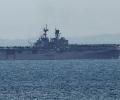
Although extensive air attacks have been carried out to destroy most of Iran's defence capabilities, the latter's resilience and sustenance during the war clearly indicate that the US landing force would encounter severe resistance in the operation, explains Commodore Venugopal Vengalil (retd).

Sri Lanka has allowed a second Iranian ship, IRINS Bushehr, to dock at Trincomalee port after it reported engine failure, following the sinking of an Iranian frigate. The move comes amidst heightened regional tensions and a joint US-Israeli attack on Iran.

Iranian foreign ministry spokesperson Esmaeil Baghaei said that the country has held no "direct" talks with the United States as of now and added that it has received messages through some mediators regarding the US' desire for negotiations.
Iran has announced the Strait of Hormuz is open to commercial vessels, coinciding with a ceasefire between Lebanon and Israel.

Amidst escalating regional tensions, Sri Lanka is carefully considering its response after a second Iranian ship requested entry into its waters following a reported US submarine attack on an Iranian frigate near Galle.

In a post on Truth Social, Trump outlined key goals of the campaign, including degrading Iran's missile capabilities, dismantling its defence industrial base, eliminating naval and air power, preventing Tehran from acquiring nuclear capability, and protecting United States allies such as Israel, Saudi Arabia and the United Arab Emirates.

28 Indian vessels carrying 778 seafarers are stranded in the Persian Gulf, prompting government monitoring and coordination to ensure their safety and security.

The Iranian military has asserted that its forces successfully targeted and downed a US A-10 aircraft, according to a report by Al Jazeera.

Sri Lanka is deliberating appropriate action after a second Iranian ship sought entry to its territorial waters, following an attack on an Iranian frigate near the island nation. The government is focused on safeguarding lives and regional peace.

Two more Indian-flagged LPG tankers have safely navigated the Strait of Hormuz, ensuring continued cooking gas supply to India amidst regional conflict. These tankers are expected to reach Indian shores soon, following the successful transit of previous vessels.

China calls the shoal Huangyan Dao. China has already deployed some of its biggest CCG vessels in the area to assert its claims.

The US Navy seized an Iranian-flagged cargo ship in the Gulf of Oman, escalating tensions as ceasefire talks face uncertainty. The incident raises concerns about the fragile ceasefire and the ongoing blockade of the Strait of Hormuz.

On Saturday, it was reported that a drone strike had targeted the Fujairah Port in the UAE, triggering a fire.

Trump said that Iran's leadership, along with its air defence, Air Force, and Navy are 'gone'.

In a bid to de-escalate Middle East tensions, the US has presented Iran with a comprehensive 15-point peace plan focusing on nuclear disarmament and regional stability in exchange for sanctions relief.

US President Donald Trump has indefinitely extended the ceasefire with Iran at the request of Pakistan, aiming to allow Tehran's leadership time to form a unified proposal to end the seven-week war.

Iran's ambassador to India, Mohammad Fathali, has described India as a "reliable and compassionate" partner while asserting Tehran's territorial authority over the Strait of Hormuz amidst ongoing regional tensions.

18 Indian-flagged vessels with 485 Indian seafarers still remain in the western Persian Gulf region

The diplomatic intervention follows various media reports which attributed comments to Iranian lawmaker Alaeddin Boroujerdi, suggesting that merchant vessels were being charged USD 2 million for safe passage through the "conflict-hit Hormuz."

IRGC said vessels seeking to sail through the strategically critical Strait of Hormuz must obtain Iran's approval; otherwise, they could become targets of Iranian attacks.

The clock on the ceasefire is running out. But everyone's already whispering about round two, possibly as soon as this weekend.

Amidst rising tensions, Iran threatens to close the Strait of Hormuz to those not adhering to its new regulations, signaling a potential escalation in the region's geopolitical landscape and raising concerns about global oil supply routes.
